




"Quave helped us turn Neotrust from a reporting service into a real product. They took a massive, complex data operation and built a platform where our clients can explore insights on their own, in real time."
— João Francisco Martins, CEO
The Starting Point
Neotrust is one of the main sources of e-commerce data in Brazil, processing more than 2 million transactions per day. Brands and retailers rely on its data to track prices, market share, and trends across online stores.
As the volume and richness of data grew, most insights were delivered through reports or CSV files. This worked well for structured analyses, but answering new questions often required generating new exports - introducing delays and operational dependency.
Over time, client expectations evolved. Teams wanted to explore the data on their own, ask questions in real time, and move faster in their decision-making. They were looking for a more interactive and product-driven way to access insights. This shift marked a natural next step for Neotrust: transforming a highly valuable data operation into a software solution that puts exploration and insight directly in the hands of its users.
The Challenge
Neotrust already served large companies with rigorous contractual and legal limits on data. Every change required total compliance with LGPD and even stricter data governance requirements.
The users were also very different. Some teams had analysts. Others had just one person. Some only cared about big events like Black Friday. Others used the data every day.
Handling data at scale was already a significant technical challenge. But as Neotrust evolved toward a product, another layer of complexity emerged: flexibility. With CSV files, each client could group and label things their own way. The new product had to keep that freedom without turning into chaos. Neotrust could not simplify the data model or restrict client autonomy just to make the software easier to build.
The Approach
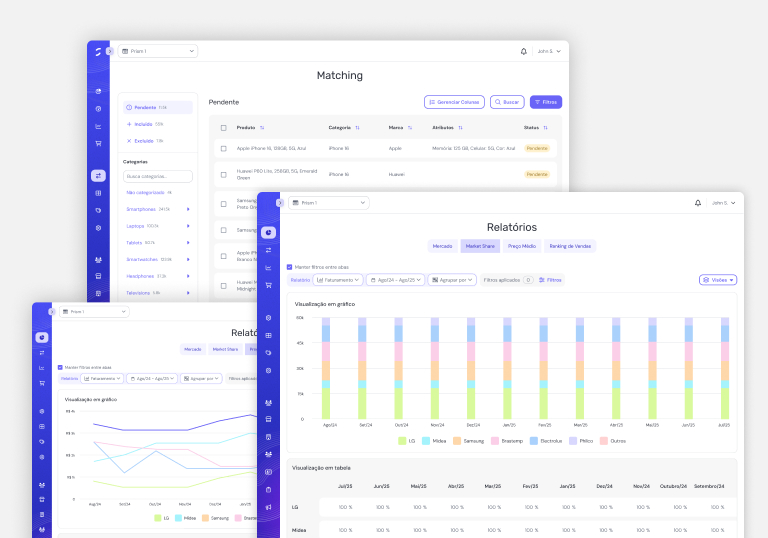
We rebuilt Neotrust as a platform. Instead of shipping files, we built a web app. It handles users, companies, access rules, and client-specific views. Different products now run on the same data core.
Each client can look at the same raw data and see it in their own way. They set their own groups, rules, and tags. These prisms shape how products, prices, and brands appear across the system. This kept the freedom people had with CSV files, but made it work at scale.
We did not wait months to get it right. We built a small version first. It used less data and simple flows. We shared it with clients. We learned what broke. We fixed it. Then we built more.
Design and development moved together. Team members worked side by side (using Figma MCP, Cursor, and more) to turn ideas into front-end code fast. That speed let us spend our time on real problems instead of basic UI work.
We used AI in the early stages of the project to help test ideas, explore flows, and check assumptions before we locked them into the product. The team stayed close to clients the whole time, and their questions shaped what came next.
What We Built
Neotrust v2 is one platform with multiple products built on top of the same core. Market Insights gives enterprise teams deep views into prices, share, and competitors. Discovery lets smaller teams explore trends on their own. Seasonal tools like Black Friday use the same data foundation to help teams monitor and analyze key moments in the retail calendar.
Prisms sit at the center of the system. Each client can set their own product groups, matching rules, tags, and custom fields. That logic flows through every report and view. Custom setup is now part of the product, not something handled by support.
We also built AI into the platform to make the data easier to use. The system scans each client's data every day and highlights changes that matter to their prisms. These updates appear in the product, so teams can see what shifted without digging through charts.
We added an AI chat as well. Users can ask questions in plain language instead of clicking through filters and tables. The system is composed of a bespoke Text-to-SQL agent that turns those questions into data queries and returns clear answers, always following the same access and privacy rules as the rest of the platform.
The interface hides the hard parts. Users do not see data pipelines or schemas. They see clear steps and steady results. A change in one place updates the whole system, so reports and insights stay in sync.
The Result
Neotrust now works like a software company, not a reporting service. Clients can answer more questions on their own. Teams move faster. New products can launch on the same base without redoing the data. Most of all, the system can grow without breaking trust or legal rules.
What Made It Work
We built a platform, not a set of one-off tools, which gave Neotrust a base it could grow on.
Legal and data limits were treated as part of the design, not as blockers, so they shaped how the product worked instead of slowing it down.
Tight loops with real users kept the team honest. Teams saw early versions, asked questions, and pushed back when things did not make sense, so weak ideas did not last long.
Related Work
This case study covers the product and the experience layer of Neotrust. The data platform behind it also went through a major rebuild, including pipelines, storage, and migration, and that work is documented in a separate case study focused on the Neotrust infrastructure.
Read another case study:

Enhancing the Camping Experience with AI.
Read Case Study →