




"Quave brought Sekr back to life, delivering exactly what we needed in record time. From AI-driven trip planning to a seamless cross-platform experience, they rebuilt our app with modern features."
— Jordan Schwartz, CPO
A Community Worth Saving
Eighty thousand campers used Sēkr to find places to sleep, plan routes, and meet fellow travelers. The app held over 60,000 locations — free campsites, RV parks, and boondocking spots — many reviewed and photographed by the community itself.
Then the previous owners walked away. Updates stopped. The app sat untouched for months. Harley Sitner and Jordan Schwartz acquired Sēkr in late 2023. Both were longtime users who knew what the app meant to people, and they knew it needed more than a fresh coat of paint.
They wanted AI-powered trip planning. They wanted a desktop version. And they wanted it live before summer, when campers start booking trips. That gave us under three months to rebuild the entire app.
The Challenge
The old codebase was a dead end. Years without investment had left it brittle. The architecture couldn't support AI or a desktop experience. Trying to add new features on top of old tech would have taken longer than building fresh.
Beyond the technical debt, the AI feature posed its own problem. Harley and Jordan wanted users to plan trips through natural conversation, but Sēkr's value lived in its database of more than 60,000 locations. Connecting an AI to that data — while keeping suggestions relevant to a user's actual route — required careful design.
The Approach
We made the call early: rebuild from scratch using Meteor. One codebase for mobile and desktop. Faster to build, easier to maintain.
For the AI trip planner, we used a RAG approach with Qdrant. The system takes a user's natural language input, searches for matching locations, then passes everything to an LLM that builds the final itinerary. It draws from both our data and public sources. When our database has gaps, the system pulls from external APIs to fill them. When users add a new location to the map, we fetch details from Google Places — images, descriptions, and reviews — so every spot feels complete. All of this runs in the background while users interact with a simple chat window.
Designing the Experience
User research showed that campers usually know where they're starting and where they want to end up, but not the details in between. The trip planner needed to support both planning ahead at home and adjusting on the road.
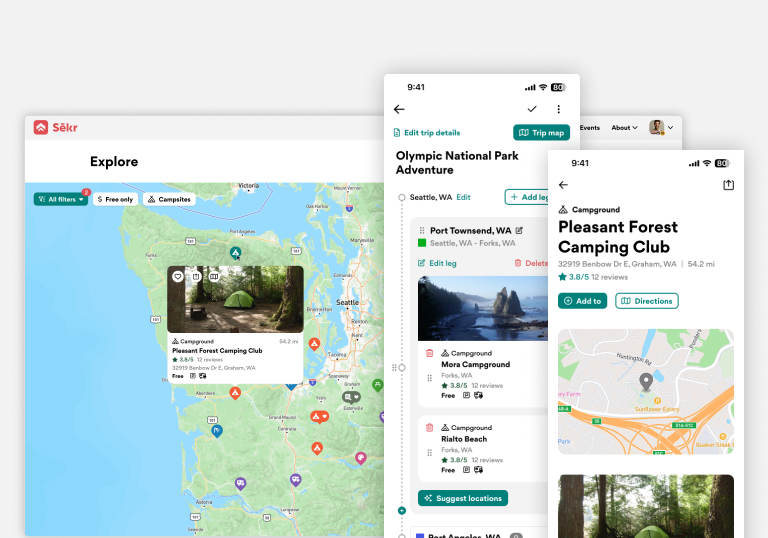
We iterated constantly to get it right. Users can let the AI handle everything, do it all manually, or mix both however they like. Someone might plan most of a trip by hand but ask for suggestions on just one leg. Another might let the AI draft the whole route and then tweak it. Exploring also feels easy — the map invites wandering, and anything interesting can become part of the trip with one tap. The result is a planner that feels helpful without getting in the way.
What We Built
AI trip planner. The planner connects Sēkr's database of 60,000+ locations to a conversational AI. Users describe what they want — overnight spots with showers, scenic hikes, local food — and the system suggests places that match. When a location isn't in our database, we pull details from Google Places so it still feels complete with photos and descriptions.
Desktop and mobile. The old app only worked on phones. Now users can map out their route on a laptop at home and pull up the same trip on their phone when they hit the road. The experience stays consistent across both.
Refreshed core features. We rethought the map, search, and location pages. Everything is cleaner, faster, and easier to find, even though the app does more than before.
Ready for Summer
We delivered the new app in under three months. It launched in time for the camping season. Sēkr now has AI trip planning that actually works, runs on desktop and mobile, and gives the loyal community an app that finally matches their dedication.
Read another case study:

Rebuilding a Market Leader from the Ground Up.
Read Case Study →